
Auto-translated. This article was machine-translated to help readers. If meaning differs, the Indonesian version is the primary reference. ID · Report translation issue
Paradigm Shift: Why the Traditional Perimeter Is Dead in 2026
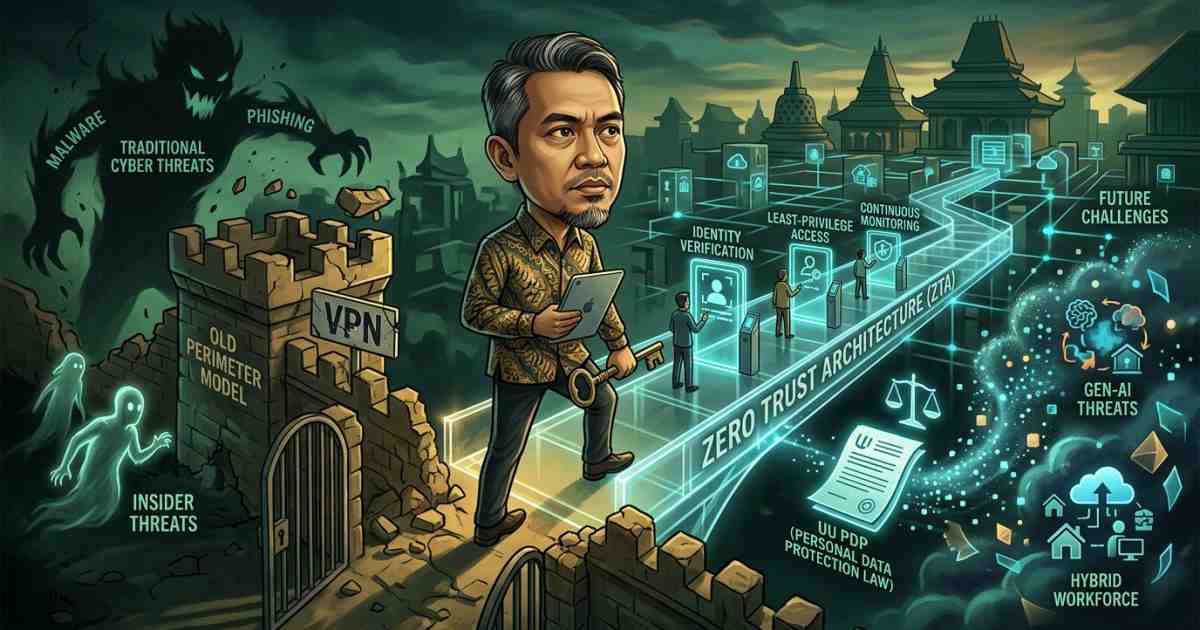
For years, information technology security infrastructure in Indonesia has relied on a traditional perimeter defense model. This concept works like a medieval fortress: building thick walls of firewalls and VPNs to protect assets inside, while assuming that anyone who successfully enters the internal network is a trusted entity. However, entering 2026, the digital landscape has changed radically. Physical office boundaries have dissolved along with the massive adoption of hybrid work environments, multi-cloud migration, and the integration of personal devices (BYOD) and IoT.
When the physical perimeter is lost, the assumption of implicit trust becomes the biggest security gap exploited by hackers. Once an attacker successfully breaches a single weak point, they can perform lateral movement without hindrance to reach the company's most sensitive data. Facing this new reality, CTOs and IT managers in Indonesia are now turning to ManageEngine Blog which confirms that Zero Trust Architecture (ZTA) no longer merely a tactical option, but a mandatory standard for business continuity.
Three Main Pillars Driving Zero Trust Adoption in Indonesia
Zero Trust implementation in the country is driven by three interconnected critical factors: the escalation of artificial intelligence (AI)-based threats, the complexity of hybrid infrastructure, and the strict enforcement of national regulatory compliance.
1. Explosion of AI-Based Cyber Threats
Cybercriminals are now leveraging generative AI to launch faster, automated, and harder-to-detect attacks. Traditional methods that rely on signature-based detection have proven to no longer be adequate to counter modern tactics such as highly realistic deepfake messages, personalized automated phishing campaigns, and adaptive malware. Based on data from the National Cyber and Crypto Agency (BSSN), billions of cyber traffic anomalies have been recorded, most of which exploit these advanced techniques. In a Zero Trust architecture, every access request is treated as a potential threat, thereby limiting the attackers' movement even if initial defenses are breached.
2. Complexity of Hybrid and Multi-Cloud Work Environments
Companies in Indonesia now manage a highly distributed technology ecosystem. Employees access business applications from home, cafes, or out of town using unsecured public networks. At the same time, corporate data is spread across various local data centers as well as global cloud service providers. The Zero Trust model addresses this challenge by shifting the security focus from physical network locations to identity validity and device health in real-time.
3. Regulatory Compliance and Shared Responsibility
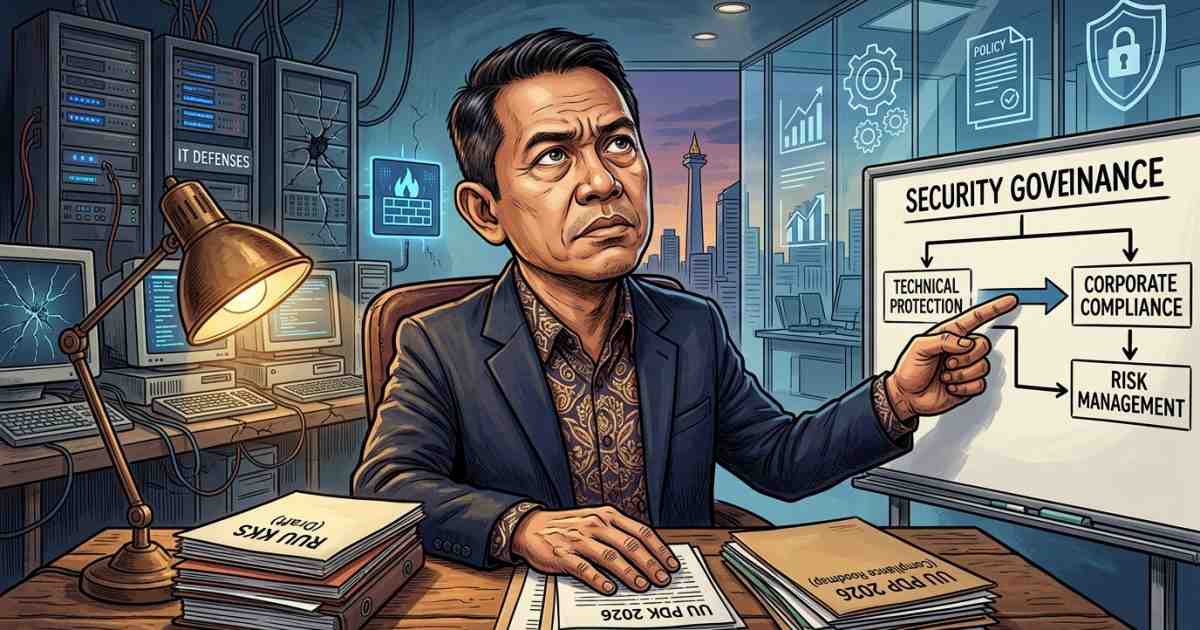
The regulatory aspect is also a key driver. With the full enforcement of sanctions under the Personal Data Protection Law (PDP Law) and Presidential Regulation Number 47 of 2023 on the National Cybersecurity Strategy, companies in Indonesia face severe legal consequences and heavy financial fines in the event of a data breach. The government, through the Ministry of Communication and Digital (Komdigi), continues to emphasize the importance of collaboration and the implementation of shared responsibility in maintaining national cybersecurity, as emphasized in Ministry of Communication and Digital. Zero Trust inherently helps organizations meet these compliance standards through well-documented verification and monitoring of access activities.
Basic Principle of Zero Trust: "Never Trust, Always Verify
Fundamentally, Zero Trust Architecture operates on the core principle:never trust, always verify. This approach rejects granting automatic trust to any user, device, or application, regardless of their physical location. According to a review in Republika, there are several technological pillars combined in this architecture to create a solid defense:
- Risk-Based Multi-Factor Authentication (MFA): Identity verification no longer relies solely on static passwords, but rather on a combination of tokens, biometrics, and contextual analysis such as geographic location and access time.
- Least Privilege Access (Least Privilege Access): Users are only granted the limited access rights they truly need to complete specific tasks, to minimize the risk of account misuse.
- Micro-segmentation (Micro-segmentation): Breaking down the internal network into smaller secure zones. If one segment is successfully compromised, the impact will not spread to the entire corporate infrastructure.
- Continuous Monitoring and Analysis: Performing real-time monitoring of user and device behavior to instantly detect anomalies and automatically respond to threats.
Implementation Guide for Indonesian CTOs and IT Managers
Adopting Zero Trust is not a one-time project completed overnight, but rather a continuous digital transformation journey. For IT leaders in Indonesia, here are the strategic steps that can be prioritized in 2026:
1. Map Critical Assets and Data Flows
A crucial first step is to identify and map network services, applications, and sensitive data that have the highest business value. Focus initial protection on these critical assets before expanding the architecture across the entire organization.
2. Strengthen Identity and Access Management (IAM)
Make identity your new perimeter. Implement a Single Sign-On (SSO) solution integrated with adaptive MFA. Ensure every access policy is evaluated based on device context, not just user credentials.
3. Device Health Validation (Endpoint Security)
Before allowing a device to connect to the corporate network, ensure the system can verify its security status. The device must be ensured to be running the latest operating system, have active security patches, and be free of malware.
4. Optimize Operational Cost Efficiency
In addition to enhancing security posture, the implementation of Zero Trust also offers significant economic efficiency for companies. By automating verification processes and leveraging cloud technology, organizations can reduce reliance on expensive traditional hardware and minimize the manual workload of security operations (SecOps) teams.
Conclusion: Building Future Cyber Resilience
In 2026, cyber resilience is no longer just a matter for the IT department, but rather an important pillar of the business continuity strategies of companies in Indonesia. By adopting Zero Trust Architecture, companies not only protect their sensitive data from increasingly sophisticated AI threats, but also build a strong foundation to innovate safely in the hybrid work era.
Smart Updates in a World That is Too Fast with Nuupdate.com
Source
- Zero Trust Implementation: What Indonesian Enterprises Should Prioritise in 2026
- Press Release No. 432/HM/KOMINFO/07/2024 on Enhancing Cybersecurity, Deputy Minister of Communication and Informatics: Implement Shared Responsibility
- Implementation of Zero Trust as an Effort to Protect Against Cyber Attack Threats
FAQ
What is the fundamental difference between traditional security and Zero Trust?
Traditional security relies on perimeter defense (such as firewalls) and grants automatic trust to users inside the network. In contrast, Zero Trust adheres to the principle of 'never trust, always verify', where every access request must be validated regardless of the connection's origin.
How does Zero Trust help with compliance with the PDP Law in Indonesia?
Zero Trust restricts data access only to verified parties through the principle of Least Privilege Access and records every activity in real-time. This minimizes the risk of personal data breaches and simplifies compliance audits in accordance with the regulatory mandate of the PDP Law.
Does implementing Zero Trust require a very high cost?
Although it requires an initial investment in IAM and endpoint technologies, Zero Trust provides long-term cost efficiency. This approach reduces the need for expensive traditional perimeter hardware and minimizes recovery costs from data breach incidents.

Diskusi & Komentar
Bagikan insight kamu, ajukan pertanyaan, dan bantu pembaca lain memahami topik ini dari sudut pandang yang berbeda.