
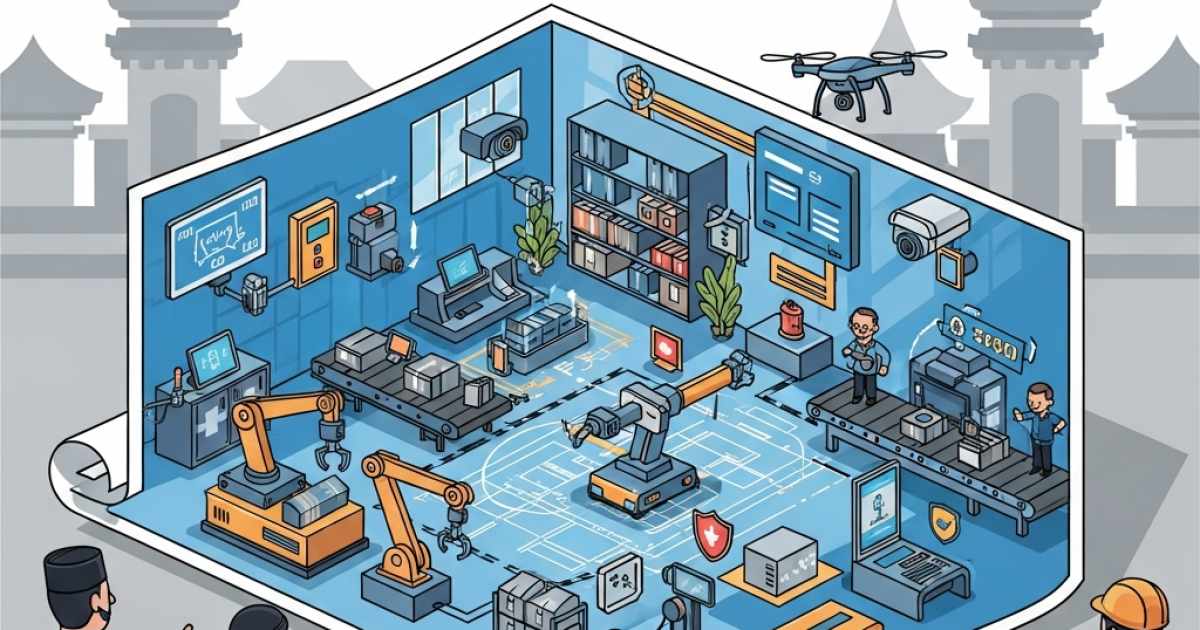
In the increasingly complex and dynamic supply chain landscape, warehouse operational efficiency becomes crucial. The existing challenges are not limited to storage capacity but also include data accuracy, process speed, and the mitigation of human error risks that can occur at any time. This is where the crucial role ofWarehouse automation with security systemhas become the foundation of successful strategies for many companies today.
Building Strategic Foundations: Pillars of Automation and Security in Warehouse Management Systems
The paradigm shift from conventional warehouses to smart warehouses demands a more integrated approach. Awarehouse management systemAn effective Warehouse Management System (WMS) no longer just manages inventory, but functions as an orchestrator of all operational activities. This includes goods receipt, storage, picking, and shipping, all with a high degree of precision.
Modern WMS implementation strategies must center on two main pillars: automation and security. Automation reduces reliance on manual intervention, which is inherently prone to errors. For example, automatically recording goods entering or leaving through sensors, barcodes, or RFID minimizes riskhuman error, even when employee conditions are not optimal. In this context, the solutionwarehouse management systemintegrated, as offered by digital platforms, can ensure every movement is accurately recorded in real-time.
Security aspects are no less important. The integrated security system in an automated warehouse includes strict access control, advanced CCTV monitoring, and anomaly detection sensors. A platform that provides integrated access control allows only authorized personnel to access certain areas, is digitally recorded, and is directly connected to operational indicators. This creates a safe and controlled environment, protecting important assets and data. A 2022 study by The Council of Supply Chain Management Professionals (CSCMP) emphasized that the integration of security systems and automation increases operational integrity by up to 30%.
Implementation Strategy and Continuous Optimization
AdoptstrategyWarehouse automation requires careful planning. The initial stage is an in-depth analysis of specific needs and existing workflows. After that, selecting appropriate technology, ranging from automation hardware (e.g., automatic conveyors, AMR robots) to WMS software, becomes crucial. It is important to choose a flexible and scalable system, capable of adapting to future business growth.
System integration is the next step. WMS does not stand alone; it must be connected to other systems such as ERP (Enterprise Resource Planning), transportation systems, and even e-commerce platforms. Data synchronization between systems ensures end-to-end visibility and facilitates better decision-making. One example of strategic implementation is the use of a management platform that can seamlessly integrate various aspects of warehouse operations and security, such as that offered bySIMPLO.id, which is designed to help property and asset management become more organized, and can even automate many vital processes.
Continuous optimization is also key. After implementation, it is important to continuously monitor performance, identify areas for improvement, and regularly train staff to maximize the system's potential. Responses to market and technological changes must be agile, ensuring that investments inWarehouse automation with security systemcontinue to provide added value.
Closure
The future of warehouses is about intelligence and connectivity. By implementingwarehouse management system strategythat focuses on automation and integrated security, companies can not only overcome daily operational challenges but also build a solid foundation for long-term efficiency and market competitiveness. This is a strategic investment that will continue to reap benefits in the digital era.
Smart Updates in a World That's Too Fast with Nuupdate.com



Diskusi & Komentar
Bagikan insight kamu, ajukan pertanyaan, dan bantu pembaca lain memahami topik ini dari sudut pandang yang berbeda.