

Auto-translated. This article was machine-translated to help readers. If meaning differs, the Indonesian version is the primary reference. ID · Report translation issue
Why the Traditional Perimeter Is No Longer Enough in 2026?
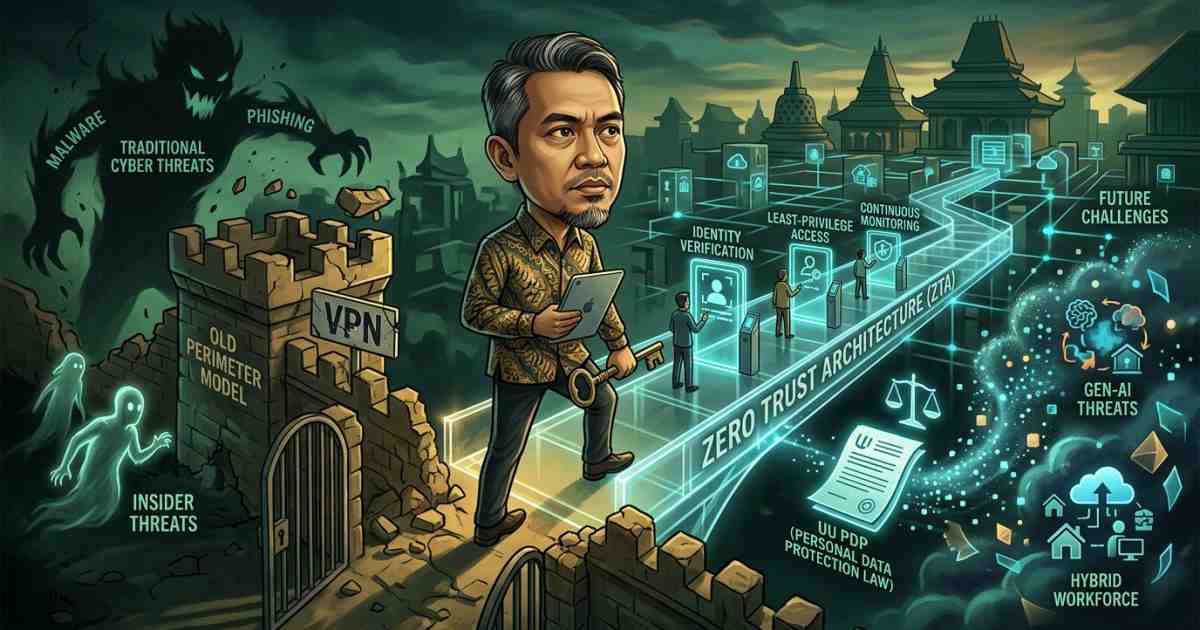
The cybersecurity landscape in Indonesia has changed drastically. Entering 2026, traditional perimeter-based security models—such as relying on robust firewalls at the outer gate and VPNs for remote access—have been declared obsolete. Based on data from the National Cyber and Crypto Agency (BSSN) which recorded a massive surge in cyber anomaly activities in Indonesia, IT teams can no longer assume that anyone inside the internal network is a trusted entity.ManageEngine Blog.
Two main drivers forcing CTOs and IT Managers in Indonesia to immediately switch to Zero Trust Indonesia is the rapid development of artificial intelligence (AI)-based cyber threats as well as increasingly strict law enforcement under the Personal Data Protection Law (UU PDP). In an era where attackers use AI to modify attack tactics in real-time, the security approach must shift from mere passive prevention toward adaptive cyber resilience.SATU University, ManageEngine Blog.
Three Main Pillars of Zero Trust Architecture (ZTA)
According to the framework released by CSIRT Bappenas, Zero Trust Architecture (ZTA) is built on three basic principles that must be integrated into the company's IT infrastructure.Bappenas CSIRT:
- Never Trust, Always Verify: Every access request—whether from inside or outside the office—must be strictly verified based on user identity, device condition, geographic location, and activity context.Bappenas CSIRT.
- Least-Privilege Access: Limiting user access privileges to the bare minimum. Employees are only granted permission to access data or applications that they absolutely need to complete specific tasks at a given time.Bappenas CSIRT.
- Assume Breach (Assume a breach has occurred): Design your system assuming that outer defenses have been breached. By dividing the network into small segments (micro-segmentation), you can prevent attackers from performing lateral movement to other critical systems if an account or device is compromised.Bappenas CSIRT, Phintraco Group.
Dual Urgency in 2026: AI Threats & PDP Law Compliance
Why has the implementation of Zero Trust in Indonesia become so urgent right now? There are two main interrelated factors:
1. Increasingly Sophisticated AI-Based Cyberattacks
Cybercriminals are now leveraging generative AI and automation to launch highly personalized phishing campaigns, dynamically modify malware code, and even bypass simple authentication mechanisms.SATU University. To combat it, companies must use AI-based defenses integrated with Zero Trust architecture. Predictive AI can analyze unusual access signals in real-time and automatically trigger re-verification or terminate suspicious sessions before damage spreads.Bappenas CSIRT.
2. Law Enforcement of the PDP Law (Personal Data Protection Law)
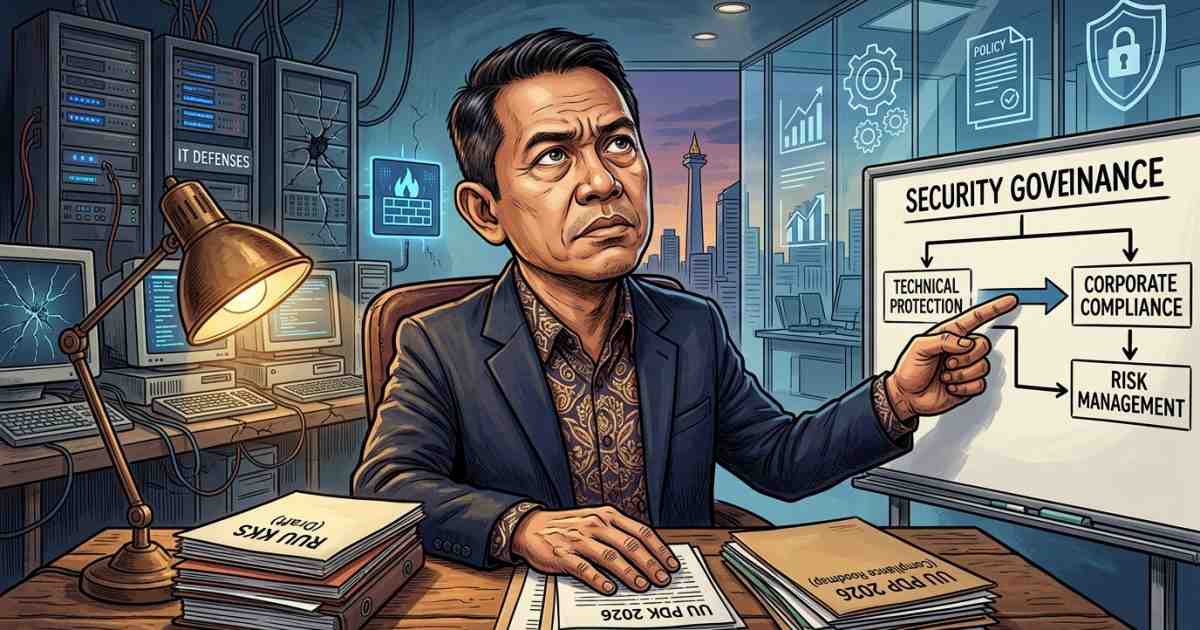
Since its enactment, the PDP Law has entered a new era of strict law enforcement under the supervision of the relevant authority.Ministry of Communication and Digital. Failure to protect the personal data of customers or employees not only damages reputation, but can also result in very large administrative fines up to criminal liability for data controllers.Ministry of Communication and Digital. Adopting Zero Trust helps organizations prove compliance by demonstrating strict and well-documented data access controls.
Step-by-Step Guide to Migrating to Zero Trust
For Indonesian companies looking to begin the transition from a perimeter model to Zero Trust, here is a tactical implementation roadmap that can be applied:
Step 1: Identification and Classification of Data Assets
The first step is not to buy new technology, but rather to understand what you want to protect. Map out where personal data (as mandated by the PDP Law) is stored, both on local servers (on-premises) and in cloud services.Ministry of Communication and Digital. Classify the data based on its sensitivity level.
Step 2: Strengthen Identity and Access Management (IAM)
Identity is the new perimeter in Zero Trust. Implement Identity and Access Management (IAM) solutions that support context-based Multi-Factor Authentication (MFA). Ensure every user is verified not only with a password, but also through additional factors such as trusted devices or biometrics.Bappenas CSIRT.
Step 3: Implement Network Micro-segmentation
Replace your flat network architecture with isolated microsegments. By limiting communication between segments, you can minimize the blast radius in the event of a cyberattack, so malware or hackers cannot easily spread throughout the entire corporate infrastructure.Bappenas CSIRT.
Step 4: Monitoring and Continuous Analysis
Use a Security Information and Event Management (SIEM) system equipped with behavioral analytics capabilities to continuously monitor data traffic. Early detection of traffic anomalies is crucial for responding to incidents before sensitive data is leaked to the public.ManageEngine Blog.
Conclusion: Strategic Steps Toward Cyber Resilience
The transition to Zero Trust is not an overnight project, but rather an ongoing transformation journey that requires commitment from top management to operational staff. In the midst of AI-driven cyber threats and the shadow of PDP Law sanctions in 2026, adopting the "Never Trust, Always Verify" principle is no longer just an option for innovation, but an absolute strategy to maintain business continuity and your company's data sovereignty in Indonesia.Bappenas CSIRT.
Smart Updates in a World That's Too Fast with Nuupdate.com
Source
- 6+ 2026 Cybersecurity Trends in Indonesia You Must Know
- Zero-Trust Architecture: The Key Pillar of Modern Cybersecurity
- New Era of Personal Data Protection
FAQ
What is Zero Trust Architecture (ZTA)?
Zero Trust Architecture is a cybersecurity framework that embodies the principle of 'never trust, always verify'. This model requires strict verification for every access request, regardless of whether the user is inside or outside the corporate network.
Why does the PDP Law encourage the adoption of Zero Trust in Indonesia?
The PDP Law imposes strict sanctions on organizations that fail to protect personal data. Zero Trust helps minimize the risk of data breaches through strict access control, encryption, and micro-segmentation, making it easier to prove regulatory compliance.
How will AI affect Zero Trust security in 2026?
AI is used by attackers to create more dynamic threats. However, on the defensive side, predictive AI helps Zero Trust systems detect access anomalies and automatically respond to threats in real-time.

Diskusi & Komentar
Bagikan insight kamu, ajukan pertanyaan, dan bantu pembaca lain memahami topik ini dari sudut pandang yang berbeda.